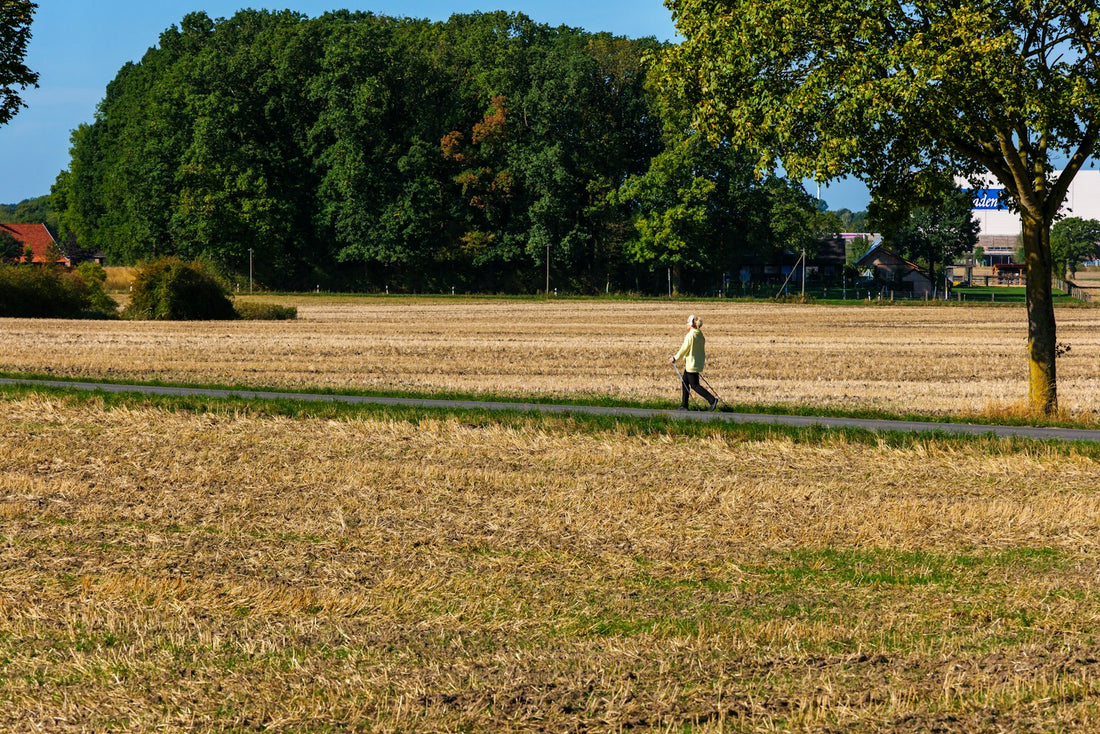
Nordic Walking: What Poles Add to a Walk
Share
You see them in the park now more than ever. Walkers using two lightweight poles, planting them with each stride, moving faster and looking oddly purposeful. Nordic walking started as off-season training for cross-country skiers. It has become a familiar sight in UK parks, and the questions that follow are fair ones. People reasonably ask whether the poles do real work, or whether they are extra kit to carry for nothing.
The short answer is that the poles change the work. At the same walking pace, using poles correctly pulls in the arms, shoulders and trunk, so your heart, lungs and muscles do more than they would on a plain walk. That extra demand is measurable in the lab, and in several patient groups it turns into better fitness and steadier blood sugar. It is a small, honest effect, not a transformation. Here is what the research actually found.
Add poles and the same walk asks more of your heart, lungs and upper body. The pace stays easy. The workload goes up.
Figures as reported in the cited peer-reviewed sources. See the Sources list below.
What the poles actually change
A normal walk is a lower-body job. Nordic walking adds a push through the pole on every stride, which recruits the triceps, shoulders, lats and trunk. Because more muscle is working, the body needs more oxygen and burns more energy for the same distance and the same comfortable pace. This is the part that is well measured.
In a 2021 crossover trial, 15 healthy adults walked on a treadmill with and without poles. With poles, oxygen uptake rose 15.8 percent, the amount of air breathed per minute rose 17.0 percent, and heart rate rose 8.4 percent, all at one unchanged treadmill setting. A 2002 field study on a running track found a matching result, with more oxygen use and more calories burned when poles were added. Across both studies, the poles lifted the intensity of an easy walk by about a sixth, without the walker going any faster.
That matters for two reasons. First, higher oxygen demand at an easy pace is a gentle way to train the heart and lungs for people who cannot or should not run. Second, the upper body is doing real work, which a plain walk does not ask of it. The arms, not the legs, carry the extra load.
What happens in patients, not just labs
A small intensity bump on a treadmill is interesting. The stronger case for Nordic walking is what it does for people with heart and metabolic conditions, where a gentle, sustainable way to raise fitness is worth a great deal.
A 2017 review pooled 15 randomised trials in people with cardiovascular disease. In coronary artery disease, adding Nordic walking to standard cardiac rehabilitation improved exercise capacity more than rehabilitation alone, with a moderate effect size of 0.49, and improved balance with an effect size of 0.55. In peripheral artery disease, the gains were larger still, with an effect size of 0.93 for walking duration and 0.64 for oxygen uptake, and the review also recorded better mobility after stroke, with an effect size of 0.80. A separate 2025 review of four trials in chronic heart failure found that Nordic walking raised peak VO2, the highest rate at which the body uses oxygen, by 2.18 ml/kg/min against usual care, and added about 16 metres to the six-minute walk distance. For a heart failure patient, that is a meaningful step toward daily independence.
The metabolic side looks similar. A 2026 review of six trials in adults with pre-diabetes or diabetes reported that Nordic walking lowered HbA1c, a three-month average of blood sugar, by 0.37 percent overall, and by 0.49 percent in those with established diabetes. Body weight fell by about 0.8 kg and HDL cholesterol rose slightly. These are modest numbers, in line with what any consistent aerobic habit delivers, which is the point. Nordic walking is one such routine that many people find easier to keep.
Where the poles do not add much
Honesty matters here, because the poles are not magic. A 2025 meta-analysis of eight studies in peripheral artery disease compared Nordic walking with supervised walking programmes without poles. For maximum walking distance, the two were about equal, and for exercise duration the plain supervised programme came out slightly ahead. The lesson is that structured, supervised walking is already strong medicine. The poles add intensity and upper-body work, but they do not beat good ordinary walking at every outcome.
The same caution applies to technique. The benefits in the lab come from actually pushing through the poles, not from carrying them like ski sticks on a flat day. Dragged or planted-but-unused poles turn Nordic walking back into an ordinary walk with extra kit. If you want the oxygen and upper-body effect, the push is the whole point.
How to start Nordic walking
You need a pair of proper Nordic walking poles with angled straps, flat ground to begin, and about 20 minutes. Trekking poles can work, but the strap system on Nordic poles is what lets you push and release cleanly. Here is a simple four-week on-ramp that fits around the UK guideline of 150 minutes of moderate activity a week.
Common mistakes
- •Carrying the poles instead of pushing them. Without the press through the strap, the upper-body effect disappears and you are back to an ordinary walk.
- •Planting the poles too far forward. The pole should land near the back foot so you can drive down and back, not out in front like a brake.
- •Gripping too tight. Open the hand at the end of each push and let the strap catch the pole. A clenched grip tires the forearms and blocks the rhythm.
- •Poles set to the wrong height. A rough guide is elbows at about 90 degrees when the pole tip is on the ground beside you. Too long or too short spoils the push.
Frequently asked questions
The bottom line
Nordic walking is a real upgrade to an ordinary walk, not a gimmick and not a miracle. The poles raise oxygen use by about a sixth at the same easy pace, bring the arms, shoulders and trunk into the effort, and in cardiac, heart failure and diabetes patients they produce measurable gains in fitness and blood sugar. The effects are modest and depend on using the poles properly. If you already enjoy walking and want more from the same time outdoors, a set of poles and a few weeks of practice is a low-cost, low-impact way to get it.
Sources
- •Baek S, Ha Y. Estimation of energy expenditure of Nordic walking: a crossover trial. BMC Sports Sci Med Rehabil. 2021. pmc.ncbi.nlm.nih.gov/articles/PMC7893942
- •Church TS, Earnest CP, Morss GM. Field testing of physiological responses associated with Nordic Walking. Res Q Exerc Sport. 2002. pubmed.ncbi.nlm.nih.gov/12230336
- •Cugusi L, Manca A, Yeo TJ, et al. Nordic walking for individuals with cardiovascular disease: a systematic review and meta-analysis of randomised controlled trials. Eur J Prev Cardiol. 2017. pubmed.ncbi.nlm.nih.gov/29067853
- •Dhamayanti AS, Rahmad R, Rachmawati S, et al. A systematic review and meta-analysis of Nordic walking for chronic heart failure with low left ventricular ejection fraction. PM R. 2025. pubmed.ncbi.nlm.nih.gov/39215750
- •Sun Z, et al. Effect of Nordic walking on walking ability in patients with peripheral arterial disease: a meta-analysis. PLoS One. 2025. pmc.ncbi.nlm.nih.gov/articles/PMC11892863
- •Chen S, et al. Effect of Nordic walking on anthropometrics, glycemia, and lipid profile in adults with prediabetes or diabetes: a systematic review and meta-analysis of RCTs. J Diabetes Res. 2026. pmc.ncbi.nlm.nih.gov/articles/PMC12782928
- •NHS. Physical activity guidelines for adults aged 19 to 64. nhs.uk/live-well/exercise