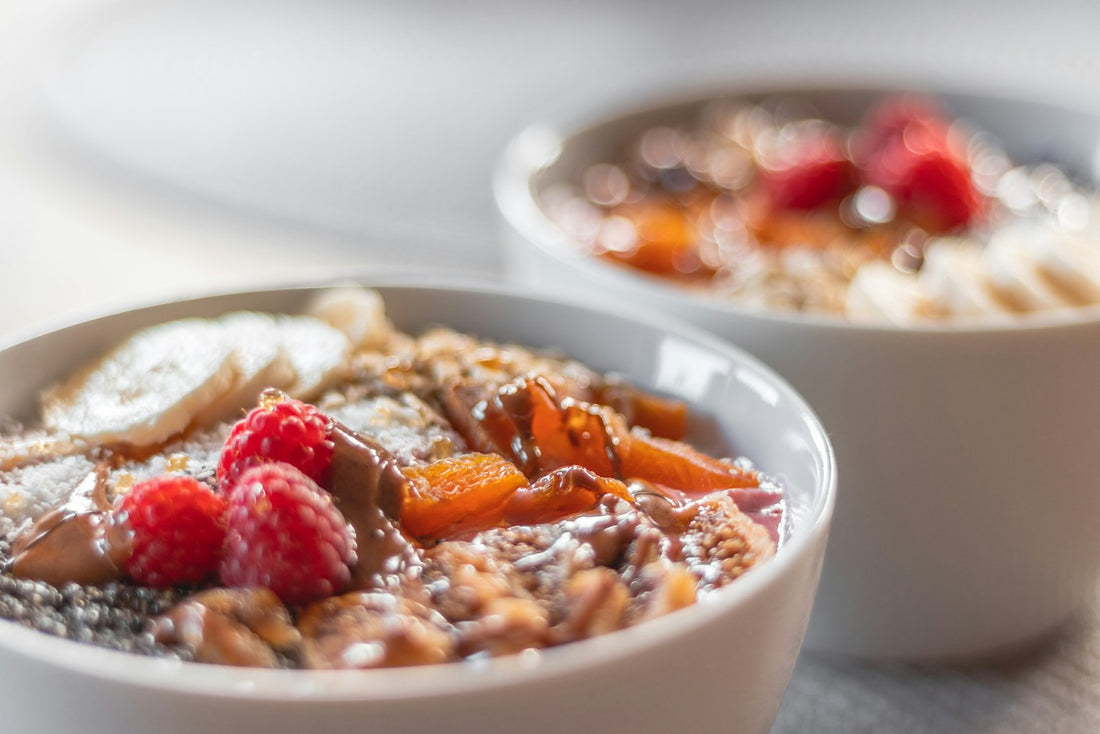
How Oats Lower Your Cholesterol
Share
High cholesterol is common in the UK, and raised LDL cholesterol is a well established driver of heart attacks and strokes. Many people assume the only lever is a statin. Diet matters too, and one of the best studied foods for the job is sitting in half the kitchen cupboards in the country. A bowl of porridge is cheap, warm on a dark morning, and backed by a large body of controlled trials. The working ingredient is a soluble fibre called beta-glucan, and the evidence that it lowers cholesterol is unusually consistent.
Oats are not a cure, and the effect is modest rather than dramatic. The appeal is that the research is solid and the change needed is small. This piece walks through what the trials actually measured, how oat fibre lowers cholesterol inside the body, how much you need in a day, and where oats sit alongside the rest of a heart-friendly diet.
What the trials actually measured
The strongest single piece of evidence is a 2014 meta-analysis in the American Journal of Clinical Nutrition, by Whitehead and colleagues, which pooled 28 randomised controlled trials of oat beta-glucan against a control. Adding at least 3 g a day lowered LDL cholesterol by 0.25 mmol/L, with a 95 percent confidence interval of 0.20 to 0.30, and total cholesterol by 0.30 mmol/L. HDL cholesterol and triglycerides did not change. The authors also found that the reduction was larger in people who started with higher LDL cholesterol, so the people with the most to gain tended to gain the most.
A second review, published in 2016 in the British Journal of Nutrition by Ho and colleagues, reached the same conclusion with a different team and a larger dataset. Across 58 trials and 3,974 adults, at a median dose of 3.5 g a day, oat beta-glucan lowered LDL cholesterol by 0.19 mmol/L and non-HDL cholesterol, a broader measure of the cholesterol that raises risk, by 0.20 mmol/L. It also nudged down apolipoprotein B, a marker of the particle number that tracks cardiovascular risk. Two separate teams, two sets of trials, and the answer points the same way.
How oat fibre lowers cholesterol
The mechanism is physical and well understood. Beta-glucan is a viscous soluble fibre, so in the small intestine it dissolves into a thick gel. That gel traps bile acids, which the body makes from cholesterol to help digest fat, and carries them out in the stool instead of letting them recirculate. To replace the lost bile acids, the liver pulls cholesterol out of the bloodstream, and circulating LDL falls as a result. The thickened mixture also slows the rate at which fat and cholesterol are absorbed from a meal. The thickness of that gel is what matters. If heavy processing or fine milling breaks the beta-glucan into shorter pieces, it forms a thinner gel, and the cholesterol effect fades.
The practical takeaway is simple. Whole rolled oats, jumbo oats, oat bran and steel-cut oats keep their fibre intact, so they are the forms the trials tended to use. Heavily processed oat products, and drinks where the fibre has been broken down, are less reliable. The simplest reading is to eat oats in a form close to how they grew.
Two reviews, the same answer
The two meta-analyses landed within a whisker of each other, as the chart below shows. Whitehead reported a 0.25 mmol/L fall in LDL and Ho reported 0.19 mmol/L, across different trials and years. That agreement is the point. When independent reviews of controlled trials agree on the same modest result, that effect is almost certainly real. It is worth being honest about the scale. A drop of roughly 0.2 mmol/L is a fraction of what a standard statin delivers, so oats are a useful addition to a heart-friendly diet rather than a replacement for medical treatment. For someone with borderline cholesterol, a drop of that size is a worthwhile nudge, and it stacks with other diet changes. Small shifts in average LDL also add up to meaningful differences in heart risk across a population.
How to get 3 grams a day
The dose that moved cholesterol in the trials was about 3 g of beta-glucan a day. A 40 g serving of oats provides roughly 1 to 2 grams, depending on the brand, so two servings a day gets most people close to the target. Here is a plan that fits a normal week without turning breakfast into a chore.
Common mistakes
- •Expecting a statin-sized result. The trials show a modest fall of around 0.2 mmol/L in LDL, useful as part of a wider diet rather than on its own.
- •Eating one small sprinkle of oats and calling it done. The dose that worked was about 3 grams of beta-glucan a day, closer to two full servings.
- •Relying on heavily processed oat snacks. Broken-down fibre forms a weaker gel, so oats closest to their whole form are the most reliable.
- •Stopping a prescribed statin without medical advice. Oats sit alongside treatment, not in place of it, so speak to a GP before changing any medication.
Frequently asked questions
The bottom line
Oats earn their reputation. Two independent meta-analyses of controlled trials agree that about 3 grams of oat beta-glucan a day lowers LDL cholesterol by roughly 0.2 mmol/L, with total cholesterol falling and HDL and triglycerides left alone. The fibre works by forming a gel that pulls bile acids out of circulation, so the liver draws cholesterol from the blood to replace them. The effect is modest and not a stand-in for a statin, but it is real, repeatable and easy to act on. Two servings of whole oats a day, kept up as a habit and not drowned in sugar, is one of the cheapest, simplest diet changes you can make for your heart. On a dark London morning, that is an easy place to start.
Sources
- •Whitehead A, Beck EJ, Tosh S, Wolever TM. Cholesterol-lowering effects of oat beta-glucan: a meta-analysis of randomized controlled trials. American Journal of Clinical Nutrition, 2014. View on PubMed
- •Ho HV, Sievenpiper JL, Zurbau A, Blanco Mejia S, Jovanovski E, Au-Yeung F, Jenkins AL, Vuksan V. The effect of oat beta-glucan on LDL-cholesterol, non-HDL-cholesterol and apoB for CVD risk reduction: a systematic review and meta-analysis of randomised-controlled trials. British Journal of Nutrition, 2016. View on PubMed
- •NHS. High cholesterol: how to lower your cholesterol, reviewed 2026. View on nhs.uk